Quick answers
Natural stone vs pavers for a patio
If you want a quick answer: pavers are usually easier to budget, easier to repair, and more consistent. Natural stone can look richer and more unique, but it often costs more and needs a careful install.
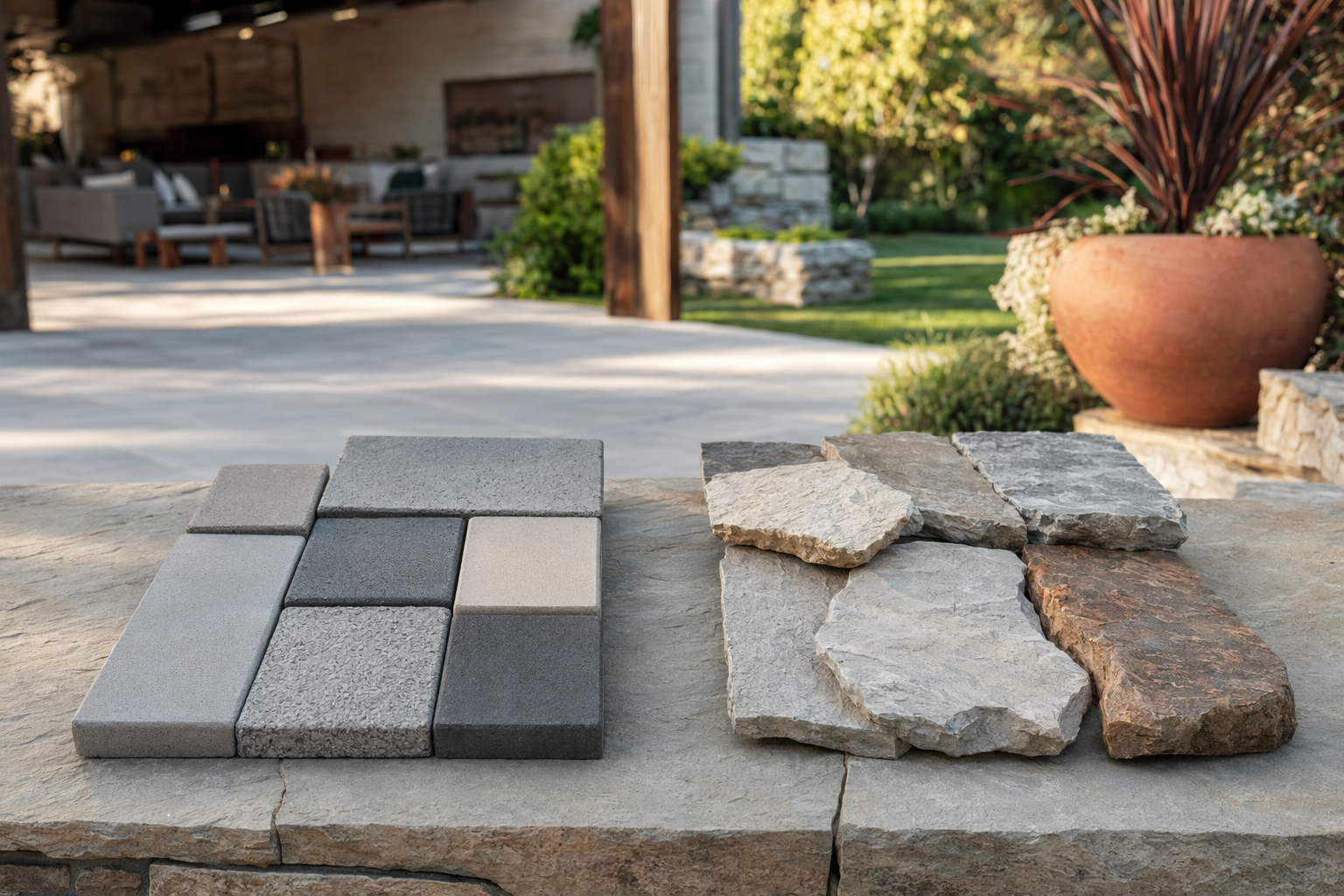
Short answer: which one is better?
Neither is "better" for every yard. For many homeowners, pavers are the practical choice because they come in standard sizes, offer a wide range of colors, and are often more predictable on cost and labor. If you want a clean, planned look and a patio that is usually simpler to repair later, pavers are often the easier path.
Natural stone is popular with homeowners who want a more organic, high-end look. Each piece has its own color, texture, and shape, so the patio can feel less manufactured and more tied to the landscape. The trade-off is that stone can be less uniform, harder to estimate, and more expensive depending on the type of stone and your site.
A good way to decide is this: if your top priority is budget control and low-fuss replacement, lean toward pavers. If your top priority is character and a one-of-a-kind look, natural stone may be worth the extra cost.
- Pavers: more uniform, often easier to price and repair
- Natural stone: more unique, often more expensive and less predictable
- The right choice depends on your budget, style, and site conditions

How they look and feel in real life
Pavers are made products, usually concrete or brick-style units, so they give you a more consistent pattern. That can be a big plus if you like straight lines, modern spaces, or a patio that matches a driveway, walkway, or pool deck. Many families also like that pavers come in coordinated systems with borders, steps, and wall blocks.
Natural stone usually gives a softer, more custom look. Bluestone, flagstone, travertine, limestone, and other stones can create a patio that feels relaxed, timeless, or upscale depending on the material and pattern. Some people love the variation in tone and texture; others prefer the cleaner, more repeatable look of pavers.
Think about your house, not just the patio by itself. A newer home with crisp lines may pair well with pavers. A cottage, traditional home, or yard with a lot of planting may look great with stone. There is no rule here, but it helps to look at photos of finished projects and ask each builder to show examples close to your style.
- Pavers fit modern, neat, repeatable layouts well
- Stone often feels more natural, varied, and custom
- Ask to see local examples in a style similar to your home
Material trade-offs: upkeep, repairs, and comfort
One big advantage of pavers is repairability. If one section settles or gets stained, individual units can often be lifted and replaced more easily than many other patio surfaces. That does not mean repairs are free or simple, but it is one reason pavers are so common. Some paver patios may also need joint sand maintenance over time, and weeds can become an issue if the patio is poorly installed or neglected.
Natural stone can last a very long time, but upkeep depends on the type of stone, the finish, and your climate. Some stones are denser and hold up well. Others can stain, chip, flake, or weather differently. Surface texture matters too. A beautiful stone that gets slippery when wet may not be the best choice around a pool or in a shady yard.
Heat is another real-life factor. Some patio materials get hotter in direct sun than others, and color also matters. Lighter colors can feel cooler underfoot than darker ones. If children, pets, or bare feet are part of the plan, ask your builder how the exact material behaves in your climate.
This is also where good local advice matters. Freeze-thaw cycles, heavy rain, drainage problems, soil movement, and slope can all affect how a patio performs. Slate & Sod is a free matching service, not a contractor, so we do not design or build patios, but we can help you connect with licensed, insured local builders so you can compare recommendations in writing.
- Pavers are often easier to repair one piece at a time
- Stone performance depends a lot on the exact type of stone
- Ask about slip resistance, heat, sealing, and freeze-thaw conditions
What they usually cost
In many US markets, a standard paver patio may land roughly around $20 to $40+ per square foot installed, while a natural stone patio may fall more around $30 to $60+ per square foot installed. Some projects come in below or above those ranges. These are general ranges, not quotes.
The real number depends on the size of the patio, the material you choose, pattern complexity, edge details, steps, walls, demolition, grading, drainage work, access to the backyard, local labor rates, and your area. A flat, open yard is very different from a sloped yard with tight access and drainage problems. Premium stone, custom cuts, and detailed layouts can push the total up quickly.
If you are early in planning, it helps to set a rough all-in budget first and then ask what material options fit inside it. You can also review more budget guidance on our costs and guides pages. Just remember: online ranges help you plan, but only a written quote from a licensed, insured local builder can tell you what your specific project may cost.
- Pavers often cost less than natural stone, but not always
- Site conditions can change the price a lot
- Ranges help planning; written quotes are what you compare
Red flags to watch for when comparing builders
No matter which material you choose, the quality of the installation matters just as much as the surface itself. A beautiful stone or paver patio can fail early if the base, drainage, or edge restraint is handled poorly. That is why it is smart to hire a licensed, insured builder and verify both.
Watch out for large cash-only deposits, vague quotes, no written contract, no proof of license or insurance, or pressure to decide right away. Those are common warning signs. You should be able to ask questions, review the scope slowly, and compare a few written quotes.
Get the scope and price in writing before work starts. The written quote should clearly say what material is being used, how much area is included, what prep or demolition is included, who handles cleanup, and whether drainage, steps, borders, sealing, or permit-related work are included or excluded. If gas or electrical work is part of a larger patio project, use licensed pros and expect permits.
Rules, permits, setbacks, HOA requirements, and what is allowed vary by area. This page is general information only, not construction, engineering, structural, or legal advice. For site-specific requirements, talk with a licensed, insured builder and your local building department.
- Verify license and insurance
- Avoid vague pricing and pressure tactics
- Get materials, scope, and exclusions in writing
How to move forward without overbuying
Start with how you want to use the patio. Quiet coffee spot? Outdoor dining? Space for a grill, fire pit, or full backyard entertaining? Once you know the purpose, it gets easier to choose the right size, layout, and material level.
Then set a realistic budget range and be honest about priorities. If your budget is tighter, pavers may let you build more usable space for the same money. If the look of real stone is the main dream, you may decide to build a smaller patio now and add other features later.
When you are ready, get matched through Slate & Sod. The service is free for homeowners. We collect basic contact and project intent details only — such as name, phone, optional email, project type, ZIP code, rough budget, and preferred language — so you can connect with licensed, insured local outdoor-living builders and compare options. You stay in control: you set the budget, compare written quotes, choose who to hire, and confirm the scope and price before work starts.
If you want more planning help first, visit our help or guides pages.
Pavers are usually easier on budget and repairs, while natural stone gives a more unique look and often costs more.
Common questions
Is natural stone always more expensive than pavers?
Often yes, but not always. The final cost depends on the stone type, patio size, design complexity, site conditions, labor in your area, and access to the yard. Use ranges for planning, but rely on written local quotes for real numbers.
Do pavers last as long as natural stone?
Both can last a long time when they are installed well and maintained reasonably. In many cases, the base prep, drainage, and workmanship matter as much as the surface material itself.
Which is easier to repair later?
Pavers are often easier to repair because individual units can sometimes be lifted and replaced. With natural stone, repair options depend on the stone type, pattern, and whether matching material is still available.
Is natural stone more slippery?
It can be, depending on the type of stone and surface finish. Some stones and finishes offer better grip than others, so ask about slip resistance, especially for pool decks, shady yards, and rainy climates.
Should I seal a stone or paver patio?
Maybe. Some materials benefit from sealing for stain resistance or color enhancement, while others may not need it or may need reapplication over time. Ask your licensed, insured builder what the exact product requires and what maintenance to expect.
How do I find someone trustworthy to build my patio?
Compare a few written quotes, verify license and insurance, and avoid large cash-only deposits or pressure to sign fast. Slate & Sod is a free matching service, not a contractor, and can help you connect with licensed, insured local builders to start that comparison.